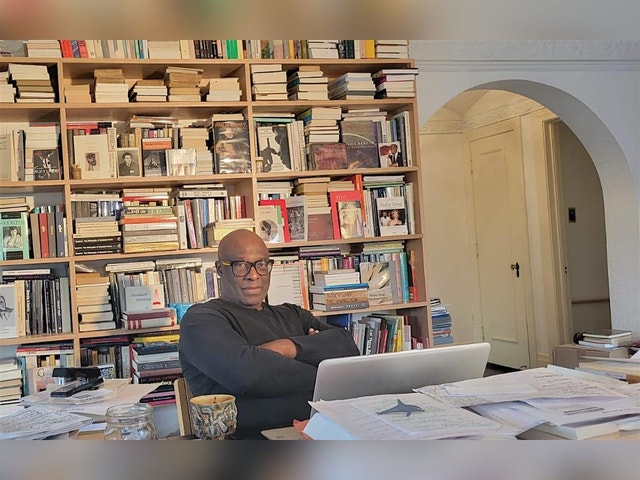
Michael Stone-Richards, The Unfinished Conversation in Art Pedagogy
Scholar-teacher Michael Stone-Richards joins BFA Visual and Critical Studies [https://sva.edu/academics/undergraduate/visual-and-critical-studies] and the SVA Honors Program [http://www.sva.edu/undergraduate/honors-program] to speak on the unfinished conversation on—and the crisis of—art pedagogy and the art school today. Says Stone-Richards, "In many ways, Plato’s Socratic dialogue, the Meno (c. 385 BCE), was the beginning of my formulating the questions which have become essential to my research since 2014 bearing on Art + Pedagogy and the crises confronting the contemporary art school—or, to be more precise, Plato’s Meno as interpreted by Kierkegaard which just stopped me in my tracks the day I sat down to read Kierkegaard’s “Thought-Project,” Philosophical Fragments. For the first time, I became fully aware that pedagogy was not and could not be fundamentally a question of the efficient delivery of information in a classroom setting; rather, pedagogy is a means by which values from beyond the classroom setting are socially reproduced, hence a crisis in values makes of the classroom a site of conflict. We—the profession of college-level art pedagogy—are in crisis; we think, however, that the crisis is primarily economic or fiscal, but it is not. The many crises confronting the contemporary art school strike at the very identity and possibility of the art school, which is, after all, a relatively recent historical phenomenon. In this presentation, we shall explore the unfinished conversation about the teaching of art and the role of art in a college or university setting stemming from the GI Bill, the result of the President’s Commission on Higher Education (1946) and published as Higher Education for Democracy (1947). We shall argue that the obvious and extraordinary success of President Truman’s GI Bill made possible by the successful economic expansion of the West forestalled many conversations in the post-World War II period bearing on the nature of pedagogy and the role of art in higher education and as a result we are in no position to address the most fundamental of problems facing the contemporary art school, namely, What is it to teach Art? The models made possible by the GI Bill are exhausted and we do not know what will replace them. Show me a teacher without students, says Socrates in the Meno, and I will show you ideas without a future. Is this [not] our predicament?" Michael STONE-RICHARDS is Executive Director of the DDD Detroit Independent Study Program in the Detroit Design District where he is also Director of Studies for the Program in Critical Studies + Art Writing. Michael has previously served as Professor of Visual Studies + Critical Practice at the College for Creative Studies, Detroit; Head of Critical Studies and Dean of Programs and Partnerships at Cranbrook Academy, and taught in Art History and Comparative Literature at Northwestern University. He has held Fellowships at the Centre canadien d’architecture in Montréal, the Alice Berlin Kaplan Center for the Humanities, Northwestern University, and at Cranbrook Academy of Art. He is the founding editor of the journal Detroit Research now hosted by the DDD Detroit ISP. He has published many essays on the poetry of Theresa Hak Kyung Cha, J.H. Prynne, Paul Celan and the Negro Spiritual, as well as essays in critical theory, art writing, and the theory of the avant-garde, and he was an early translator of the French psycho-analyst Pierre Fédida into English. He has also co-curated an exhibition on Rei Kawakubo and Comme des garcons at MOCAD and is (finally) completing a long reflection on Surrealism and fashion. Much of his current work bears on moral perfectionism and pedagogy in the contemporary art school as the symptom of transformational crisis faced with structural issues over which art schools have little to no control. His book Logics of Separation: Exile and Transcendence in Aesthetic Modernity appeared in 2011. He is currently completing two books: Life, State, Liberty: Three Essays on the Thought of Guy Debord, and Care of the City: Ruination, Abandonment, and Hospitality in Contemporary Practice (supported by a Warhol Grant, forthcoming Sternberg Press). He recently completed Living Exposure, from David Hammons to Arthur Jafa: Essays in Art Writing.