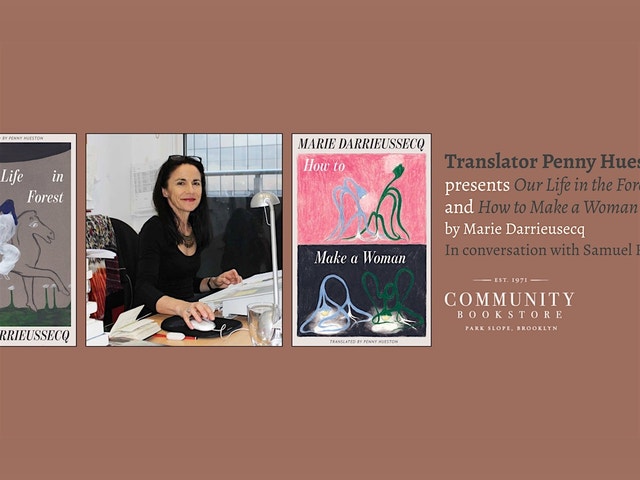
Translator Penny Hueston presents two novels by Marie Darrieussecq
Please note that an RSVP does not guarantee you a seat. We can accommodate approximately 50 seated and 80 total. If you require a seat, please plan to arrive early. About the books: Our Life in the Forest I opened my eye and BANG, everything came into focus. In the near future, our woman in the forest is nearing the end. She’s down an eye and a kidney; she’s lost the use of one hand; she knows she won’t have time to reread what she writes here. Her other half, Marie (a.k.a. Sissy)—around whom our narrator has unwisely constructed her identity, and whom she sacrificed a great deal to set free—is an idiot: deeply incurious, barely ambulatory, and horny. It’s hardly Marie’s fault (she’s a clone). But our half was hoping for more. In a torrential narrative, with asides for barking laughter, our woman in the forest casts her single roving eye across the opaque mechanisms of their shared past and the strange world that made them (one that is nevertheless familiar in its vices)—driven to understand and communicate, in writing, her conditional personhood. Our Life in the Forest is an unrelenting novel about complicity, love, and the failing body: an irreverent and deeply compelling addition to the female apocalyptic tradition. How to Make a Woman It is—to start—the 1980s, in a small village in the French Basque Country. Rose and Solange are fifteen and have been friends forever; only now Solange is pregnant. A novel in two irreducible parts, How to Make a Woman narrates, in Marie Darrieussecq’s relentless prose, the coming-of-age of these two young women against the backdrop of the final decades of the twentieth century: scenes and subcultures, the AIDS epidemic, the end of history. Rose goes to nearby Bordeaux to study psychology, maintaining an equivocal relationship with her childhood sweetheart; Solange shakes off old attachments to pursue a life on the stage and in pulsing city centers. In Bordeaux, Paris, London, and Hollywood, as they pass in and out of each other’s lives, each makes use of, and makes, the other in this bold novel—mischievous, exuberant, and radical—about sexuality, self-knowledge, and "what is done to women in the world." About the participants: Penny Hueston’s translations from French include novels by Emmanuelle Salasc and Patrick Modiano and eight books by Marie Darrieussecq. She has been shortlisted for the JQ-Wingate Prize, the Warwick Prize for Women in Translation, twice for the Scott Moncrief Prize, and twice for the New South Wales Premier’s Translation Prize, and she was the winner of the 2020 Medal for Excellence in Translation. Samuel Rutter is a writer and translator from Melbourne, Australia. His work has appeared in The New York Times, Harper's Magazine, The Paris Review, and The Los Angeles Review of Books, among others. He is the editor-in-chief of Kismet Magazine.